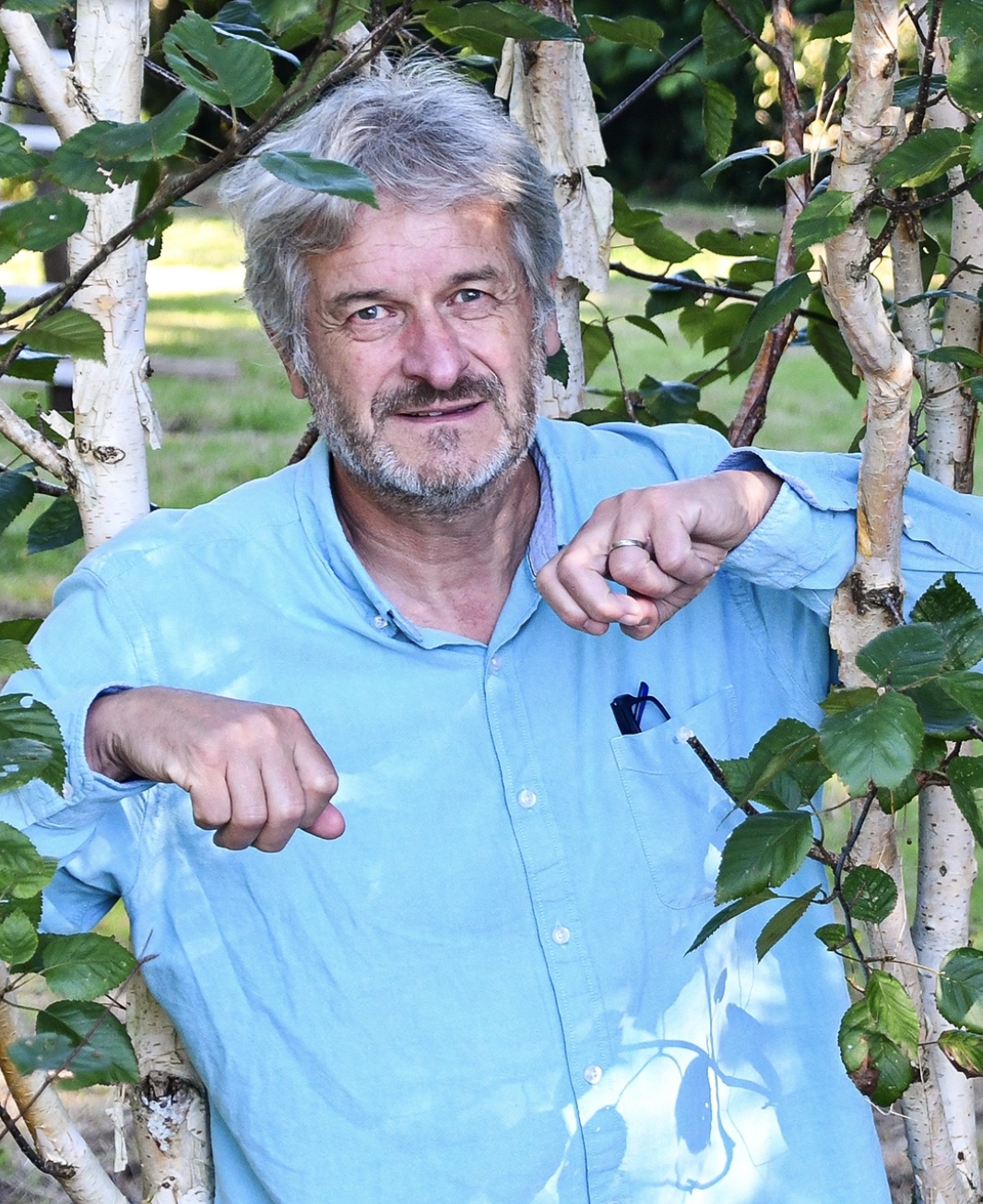
 Daniel Robert is professor of bionanoscience at the School of Biological Sciences, University of Bristol, UK. His research generally pertains to the biophysical mechanisms used by organisms to sense and acquire information from their environment. After studies in Switzerland (Neuchâtel, MSc and Basel, PhD), he enjoyed several postdoctoral research positions in Denmark, Ivory Coast and Cornell University USA, a Schering fellowship at the Institute for Advanced Study in Berlin, and a research professorship in Zürich (CH). This is at Cornell that he discovered the third principle of directional hearing by studying the auditory nanomechanics of small flies that parasitize singing crickets. This research enabled the development of bio-inspired microscale subwavelength directional microphones. Looking at mosquitoes, Robert and his team discovered active auditory mechanics in invertebrates, a process enhancing sensitivity and tuning, emulating that of humans and other mammalian species. In Bristol, Robert’s attention extended to other small animals and their miniature sensors, revealing that bees and flowers interact using static electricity, exploring their capacity to detect weak floral electric fields. Since then, Robert and his team showed that other arthropod species, such as spiders, ticks, caterpillars and treehoppers are sensitive to and use electrostatic charge and associated electric fields in various sensory ecological contexts. Collectively, Robert’s recent work reveals the existence of an electrostatic informational ecology, and the associated detection of omnipresent electrostatic fields – aerial electroreception – a sensory modality alien to humans.
Electric ecology and electroreception in arthropods
Working together to exchange nutrition for pollination services, bees and flowers interact relying on vision, olfaction, touch and humidity sensing. We have discovered that bees can also detect and learn about the weak electric field that arises as they approach a flower. This electric field is generated because flying bees are usually electrically positively charged whilst flowers tend to be negatively charged. A third component that contributes to this electric interaction is the atmospheric potential gradient (APG) that is a consequence of the ionization of the atmosphere and the global electric circuit. I will present our current understanding of this triadic interaction (Bee-flower-APG), but also explore the role that triboelectrification and Coulomb force may play in the lives of other terrestrial arthropods and plants. As electric fields are omnipresent in the environment, it is tantalizing to suggest that their presence, detection and informational value are as ubiquitous as those of light, smell and sound. This work opens up the enticing possibility that many arthropod species, in fact the majority animal species, are capable of aerial electroreception, a sensory modality previously unknown.
His talk takes place on Thursday, February 26, 2026 at 14:00 in room A113. The talk will be streamed live at https://www.youtube.com/live/3jw3A5ZeIgE.